I recently got a rather interesting request in my inbox:
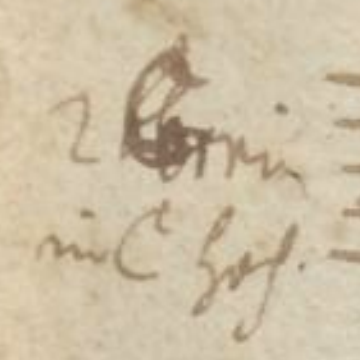
“Greetings! I hope this finds you well. I am a fellow St. Louisian looking for expert opinion regarding an old musical score manuscript (which I later found out was Joseph Haydn’s Symphony No. 56), to unlock a longstanding musical mystery. It is in the handwriting of a famous European composer from the 18th century, and I need help deciphering a single word. The word is the one that follows “in C” in the file below. The word could possibly be in Italian, since this language is used in music. It could also be an abbreviation as well, since it has a period after it.
Please let me know what you would charge to investigate this. We could locate other examples of this composer’s handwriting to aid in your research.
Thanks very much,
Roger K.
Principal Horn
St. Louis Symphony”
As I don’t often receive requests from musicians, let alone musicians asking me to solve a longstanding musical mystery, I was intrigued. I quickly glanced at the word below, curious if this musical mystery word would be easy or difficult for me to decipher.
An Excerpt of Composer Joseph Haydn's Symphony No. 56, in Haydn's Own Handwriting
Luckily, I could decipher it at first glance! It said “in C hoch” – “in high C”.
I quickly wrote Roger back, telling him what I read.
He just as quickly replied, thanking me, and then informing me that the word “hoch” had indeed come up in discussion of the manuscript, but some were puzzled by the lack of a fourth letter. Plus, the shape of the final letter seemed to resemble an archaic long s (ẜ).
“What could be going on?” he wondered.
This is a computer-generated version of the word "Hoch". Everyone's handwriting is different, but can you see the similarities?
All great questions. I replied, “The handwritten word here could either resemble ‘Hoch’ or ‘Hoh’, but the word ‘Hoh’ doesn’t exist in German. In the old German handwriting, a ‘ch’ is often written with the ‘c’ seemingly hidden – it’s just that little rise/point shortly before the final ‘h’. As for the ‘s’ question, an ‘h’ goes above and below the line of writing, just as an (English) archaic long ‘s’ would, but a German script final ‘s’ would look different – almost like the number ‘6’. ‘Hoch’ therefore seems to be very likely here.”
You can see the "final s" at the end of the second word "des", the third word "Bürgers" and the final word "Pachtwirths" in this excerpt. Looks very different from a lowercase "h"!
When looking at Haydn’s handwriting in additional scores, we can see similar final “h”s to the word in question, as seen in Haydn’s 1797 “Gott erhalte Franz den Kaiser” below.
In this 1797 composition, you can see Haydn's "h" in the words "Reich" and "brich". Can you see how it matches his "h" in "Hoch"? (https://en.wikipedia.org/wiki/Gott_erhalte_Franz_den_Kaiser)
That made sense to him. He then explained the entire situation to me:
“For years, editors had interpreted those letters as “hoch” — correctly, I now understand. But just recently some Italian researchers claimed in a new book (see below) that it spelled “bas,” short for the Italian basso, which would be low, the opposite of hoch. It would mean the horns were to play their parts an octave lower. I was kind of on board with them, and had even quoted them in a paper I was submitting to an academic journal, but then thought to do some due diligence and question their findings. I am so glad I did! Apparently they did not confer with a German paleographer. Again, thank you so much for this.”
In this footnote on page 17 of "The Horn" by Renato Meucci and Gabriele Rocchetti, the authors claim that the mystery word reads "bas," short for the Italian basso, which would be low, the opposite of "hoch." It would mean the horns were to play their parts an octave lower - but unfortunately, the Italian authors are the ones who are incorrect here. The original take mentioned, by Schultz and Landon, seems to be the correct understanding. Haydn called for the horns to be played in high C. (Update: The Italian authors have since acknowledged their mistake.)
I was so glad to get to help solve the mystery at the symphony! And the fun didn’t end there!
Since Roger is a musician with the St. Louis Symphony, he kindly told me that, as a thank you for my work, I could contact him for tickets if I was ever in my hometown of St. Louis. So this past Christmas, I took him up on his offer, and my husband and I had a wonderful date night watching “Home Alone in Concert”, with the St. Louis Symphony playing the score of the movie live. They were amazing! While Roger was unfortunately out of town, I did get to see his picture hanging up next to the other members of the esteemed orchestra. It was a night I’ll never forget – all because of the old German handwriting! You never know where genealogy will take you!
It was a beautiful and Christmasy night at the St. Louis Symphony!
15 Responses
What a great story. I hope you’ve written it down for posterity. It isn’t everyday someone gets to interpret the handwriting of a famous composer.
I loved this! As a (very amateur) horn player, I almost cringed at the reality of “C hoch” because, at least for me the higher the register, the more difficult to “hit” the high notes with assurance. As I also have a copy of that “The Horn” book, I will have to print out a copy of your “opus magnum” on the error to keep with it so that no one is ever confused again! Got to really “love” that German schrift! Thanks for your expert unraveling of the “hoch” mystery! Your certainly earned those tickets. Glad that you and your husband enjoyed the concert!
Today is my birthday and yesterday I found my grandfather ln a German newspaper. He was the first violinist in the Tri City Orchestra in Davenport, IA. My mother had told me this for years. I was looking for another relative when I saw my grandfathers name. This was in 1917 and there it was in the translation. I look forward to starting the next course. I really enjoyed your mystery today.
That’s an exciting experience and a wonderful story! It would make an interesting experiment if the SLS were to play Haydn’s piece using both interpretations of the handwriting, meaning alternately with both types of horns (high C AND low C) just to hear the difference in tonal quality! Maybe Haydn himself couldn’t decide which type of horn he preferred?!
What an exciting experience and a wonderful story! It would make an interesting experiment if the SLS were to play Haydn’s piece using both interpretations of the handwriting, meaning alternately with both types of horns (high C AND low C) just to hear the difference in tonal quality! Maybe Haydn himself couldn’t decide which type of horn he preferred?!
Such an interesting and unusual experience! Who gets to read the handwritten text of a world famous composer, much less correct the mistakes of those who tried to read it before you did. Well done!
I loved this story! A musical German mystery! It was a very enjoyable read. I also really enjoyed how you solved it. Thank you for an enjoyable educational transcription lesson. Plus Haydn. Wow!
Good choice of concert tickets! I love watching movies with a live score, it adds so much to the experience.
I will finally get a chance to start my Reading the Old German Handwriting course this year, but I’ve picked up enough that I saw that sneaky little “c” in “hoch”!
We use cookies to ensure that we give you the best experience on our website. If you continue to use this site we will assume that you are happy with it.





15 Responses
What a great story. I hope you’ve written it down for posterity. It isn’t everyday someone gets to interpret the handwriting of a famous composer.
What a wonderful story! Thank you for sharing it.
I loved this! As a (very amateur) horn player, I almost cringed at the reality of “C hoch” because, at least for me the higher the register, the more difficult to “hit” the high notes with assurance. As I also have a copy of that “The Horn” book, I will have to print out a copy of your “opus magnum” on the error to keep with it so that no one is ever confused again! Got to really “love” that German schrift! Thanks for your expert unraveling of the “hoch” mystery! Your certainly earned those tickets. Glad that you and your husband enjoyed the concert!
What a great story, Katie, with far-reaching impact.
Today is my birthday and yesterday I found my grandfather ln a German newspaper. He was the first violinist in the Tri City Orchestra in Davenport, IA. My mother had told me this for years. I was looking for another relative when I saw my grandfathers name. This was in 1917 and there it was in the translation. I look forward to starting the next course. I really enjoyed your mystery today.
Enjoyed reading “Mystery at the Symphony”. Glad you get to do fun stuff other than German documents.
Thank you for sharing a great story. It was fascinating!
Reading this made me day, thank you for sharing!
That’s an exciting experience and a wonderful story! It would make an interesting experiment if the SLS were to play Haydn’s piece using both interpretations of the handwriting, meaning alternately with both types of horns (high C AND low C) just to hear the difference in tonal quality! Maybe Haydn himself couldn’t decide which type of horn he preferred?!
What an exciting experience and a wonderful story! It would make an interesting experiment if the SLS were to play Haydn’s piece using both interpretations of the handwriting, meaning alternately with both types of horns (high C AND low C) just to hear the difference in tonal quality! Maybe Haydn himself couldn’t decide which type of horn he preferred?!
Such an interesting and unusual experience! Who gets to read the handwritten text of a world famous composer, much less correct the mistakes of those who tried to read it before you did. Well done!
I loved this story! A musical German mystery! It was a very enjoyable read. I also really enjoyed how you solved it. Thank you for an enjoyable educational transcription lesson. Plus Haydn. Wow!
Good choice of concert tickets! I love watching movies with a live score, it adds so much to the experience.
I will finally get a chance to start my Reading the Old German Handwriting course this year, but I’ve picked up enough that I saw that sneaky little “c” in “hoch”!
You have the best job! Thank you for sharing! And thank you for always being such a kind and curious person.
Thanks so much for your sweet message, Laurie!