
Deciphering names in genealogical documents can be a bit of a challenge. After all, you can’t just look in the dictionary to see if your transcribed name is correct. Having a grasp on the German naming system, therefore, can be very helpful for your research. Remember these ten facts below, and understanding those German names will become much more simple!
1. “in” on the end of a last name is usually just a grammatical marker, indicating that the person with that last name was a female. My last name, Schober, may have been written “Schoberin” on a church record or certificate. When I am translating from German to English, therefore, I simply leave off the “in” of the last name, as it is a mere suffix to show that I am a female.
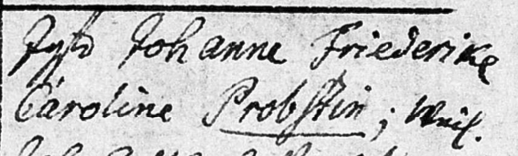 This record reads “Jgfr (Jungfrau – Miss) Johanne Friederike Caroline Probstin”. Her last name would actually be Probst.
2. A straight line over a letter in a name will usually mean that the letter below is an “n” or an “m”, and that it should be doubled. You may see this on names such as “Anna” and “Johann”, and in last names as well.
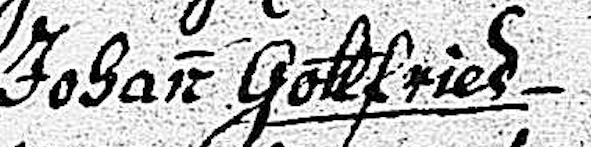 The “n” in Johann has a line above it. This means it should be doubled, and written as “Johann”.
3. Names were sometimes written in the “normal” Latin script (the script we use) instead of the old German handwriting. You may have a document that’s written entirely in the old German script, but with your ancestor’s name written in a script that looks like our modern cursive.
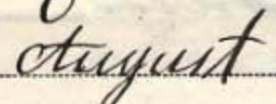 Here the name August is written in the normal Latin script – no “swoops” above the “u”, a regular cursive “s”, etc.
4. If you see a name underlined in your document, that means that this name was the Rufname, or the name your ancestor was called. Below, the child listed is “Johann Gottfried”. As “Gottfried” is underlined, this would have been the name his family called him.
5. In older documents, you may see the Latin suffix “us” on a male name: Jakobus, for example, instead of Jakob. This is the same name, so it is important to recognize both variations in your records.
6. If an older sibling died in childhood, their name may have been used for the next child born (assuming it was also a boy or a girl).
7. Children were often (but not always) named after their godparent or baptismal sponsor. If you can’t read the name in the child’s column, look to the godparent/sponsor column to: 1)See if it could be the same name, and 2) To see if that name is easier to read there.
8. “chen”, “lein”, “l”, “el”, “erl” are diminutive suffixes in German (the final three are more common in Bavaria and Austria). A young Barbara, for example, may have been called “Barbchen”. This would be the English equivalent of writing “Danny” for “Daniel.”
9. Spelling was not always the same from record to record. You may see the name Jakob in one record, Jacob in the next, and Jakobus in the third. Knowing the different variations of names and spelling can be very helpful, as it allows you to broaden your search for your ancestor. See Think Like A German: Spelling Variations in German Documents for more information.
10. If you aren’t sure if a first or last name exists, google “name guess + vorname” or “name guess + nachname) and see if any results come up. “Vorname” means “first name”, and “Nachname” means “last name”. This will show you if your transcription guess exists in German.
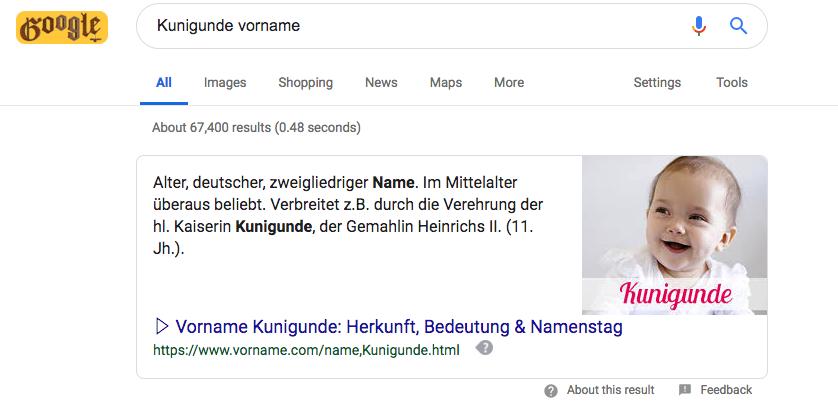
Above, I typed in “Kunigunde + Vorname” to see if Kunigunde is a name in German. Looks like it is!
Now that you know some tips about the German naming system, it’s time to go out there and find the names of your ancestors. Enjoy filling in that family tree!
For another great article on German names, see Hedwig? Jadwiga?: Overcoming First Name Translations in German Research, a guest post by our Ask-the-Translator extraordinaire Charlotte Champenois.
17 Responses
Can you tell me about the origins of name ‘Fischbach” ? They lived in Prussia, now Cruchten, Rheinland, Germany.
Great question! “Fischbach” is a locational name meaning “fish stream” (Fisch = fish, Bach = stream). It usually refers to someone who came from a town or place with that name, or to someone who lived by a stream noted for its fish. (Check this out for more info: https://www.familysearch.org/en/surname?surname=fischbach.)
EXcellent article about naming g practices. I forgot a couple of them so it was a great reminder for me
Thank you!
My original name in Germany was Ganß. So in America, I have relatives with several different spellings. Gans, Ganss, Ganz, Gantz. My direct line has been traced back as far as 1519 in Gross Umstadt. Georg Ganß, the Mayor. We came to America in 1719 having been forced to move to Holland in 1717 for switching to the Brethren (German Baptist) Religion.
That’s incredible that you’ve been able to trace your line back to 1519—and even to a mayor! That’s amazing.
Two original German spelling have been found for my surname, Holman. One is Hohlmann, the other is Heilmann, I have learned that “mann” indicates artisan or craftsman. Hohl means glass worker; Heil means helper, usually medical. How do I determine which is correct?
I find your posts interesting and helpful,,
Hi Grace, Hohlmann and Heilmann are both legitimate surnames, so the best way to determine which is correct for your line is to follow the records consistently backward and see which spelling appears most often in the original German documents. The pattern in the earliest records you can find will usually give you your answer. And don’t forget that since spelling wasn’t standardized, you are likely to come across multiple spellings (all of which are considered correct) of the same surname. For example, the h in the middle may appear and disappear for you.
Also, just a quick note: “Hohl” actually meant “plank/beam,” so “Hohlmann” was “an occupational name for a carpenter or a topographic name for someone who lived by a boardwalk” (Source: https://www.familysearch.org/en/surname?surname=Hohlmann).
As among the 50% of Americans who are of German ancestry, I enjoy toy posts and find them helpful.
Thank you so much for your information!
My German family name is Heidel from Neuenkirchen in the Saarland. Ambrose Heidel and his family emigrated to America in the 1700’s through La Harve, France. I would like their records.
There are numerous locations in Germany known as Neuenkirchen or Neunkirchen. Your intended location is likely Neunkirchen Saar (https://www.meyersgaz.org/place/20293003), which has its own Catholic and Protestant parishes. Note that the city belongs to a district by the same name, so it is likely that what you currently have is the district. To research the family in Germany, you will need to determine the hometown using U.S. records, especially church records. The Le Havre Passenger lists are not easily accessible, but you can learn about them at https://www.familysearch.org/en/wiki/France_Emigration_and_Immigration. Good luck with your research!
My grandmother was a Lange. That family came from Germany three generations ago to Wisconcin then to Iowa. Growing up, there was little conversation of ancestors so have relied on records mostly and what other relatives have found since starting genealogy research. Am retired now so can spend more time searching but need to have more paid sites that help extend that search, so really appreciate your blogs and the useful information you give. Thanks
It’s wonderful that you’re able to spend more time on your research now! I’m glad to hear the blog has been helpful. Happy searching!
Carol, Any chance that your Lange family came from the Mecklenburg Strelitz / and or Mecklenburg-Schwerin, area of Germany. I have a Lange family composed of Ernest C Toll and Fredricke K Lange. Some of their children emmigrated to Wisconsin. Fredericka Lange Toll would be my great grandmother. Does any of this sound familiar to you?
I agree about Kathryn’s site. I have learned a lot from her classes, webinars and blogs over the years.
I have two people that I know very little of, but so want to find where they came from.
Robert Falke b. 1820 in Germany is ALL I know
Gustave Rose b. 1850 in Prussia is all I know but I have always had the feeling that somehow he may have come from Poland. How can I find more about their lives?
Katherine, I hope you only the best becoming a mama again. Thankyou for always being there to help all of us.
Hi Loraine, records in Germany are kept on the local (town, parish, or civil office) level, so the town of a vital event must be determined before diving into German records. The record types most likely to list the German hometown are U. S. church records (if your family was Protestant, check out the German Immigrants in American Church Records books, as they’re a fantastic potential shortcut to U. S. church records), naturalization papers (especially post-1906), passenger lists, and military records. See https://www.familysearch.org/en/wiki/Germany_Finding_Town_of_Origin for more info.
My great Grandfather, Carl, emigrated to Philadelphia and that is all I knew when I began FTM about 20 years ago. I called his branch the “german wall” because the tree on the screen came to dead end. A casual remark by an aunt led me on a renewed quest in earnest about 2019. Last year I found the links and broke down the wall and traced the family to 1720 in Usedom, Wollin, Pommern, Prussia I sort of ran out of breath after 20 years and have slacked off.
I’d like to pick up again and so I’m trolling looking at all the internet portals. So thank you, everyone that is posting and sharing. The quest continues.
Bill Fredericksdorf, Cape May NJ