
1931. Herbert Hoover is president. America is in the middle of the Great Depression and in the final years of Prohibition. The Star-Spangled banner is adopted as the national anthem. The Empire State building is completed in NYC. And in St. Louis, Missouri, on April 17, my grandmother Nancy is born.
Looking back at all these events, 1931 seems like a different world from our fast-paced, technology-laden world of today. With this in mind, I sat down with my grandmother to find out more about her daily life in this seemingly-different era of time. Below, my questions and her answers. What was it like to grow up in the ’30s and ’40s?
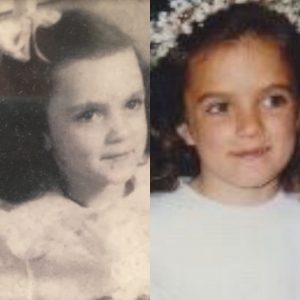

Born 55 years apart, my grandmother (left) and I (right) looked a lot alike as children.
- What kinds of things did your family do together when you were young?
On Sundays, we would go and visit grandparents and aunts and uncles. It was usually a Sunday because people worked on Saturdays back then. Some people were off every other Saturday. My dad worked at Southwestern Bell Telephone Company for half a day on Saturdays until they changed their contract to a five-day workweek in 1935.
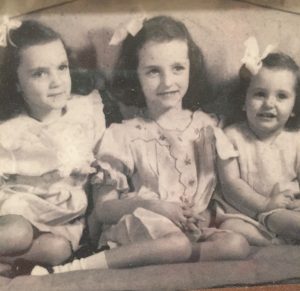
Nancy (left) and her sisters, 1930s
2. What are your memories of your grandparents (born in 1880s)?
We lived with my step-grandpa for a while when I was little. He would leave tiny milk bottles at my bedroom door in the morning, pretending to be the milkman, and we always really liked that. He babysat for me one time when I was a baby, and back then they thought that you shouldn’t give children fruit until they were older. But one day he had a watermelon and gave me some. That evening, he got in trouble for giving me watermelon, and in the coming years, whenever I started to cry, he said “Hey, didn’t I give you watermelon?” and then I thought, “Oh yes, he did give me watermelon. I shouldn’t cry” and stop.
3. What did you do with your friends when you were a kid (1930s)?
We played games like Red Light Green Light, Swing the Statue, (a kid swung you around and you were supposed to look like the statue they suggested), Rock School, Mother May I and Fly Sheep Fly (the leader (shepherd) would hide all the kids and the person who was “it” would have to go find them, using a map that the shepherd had drawn on the path he had taken to the hiding place). There was also a haunted house up the street during the depression and some hobos lived there. We always heard people there when we were playing. We also liked to catch flies in the abandoned house and then make fly soup, putting the flies in the water and stirring and stirring it.

Nancy is on the bottom right, seen with her sister Pat, half-sister Sondra and cousin Martha
4. Do you remember much about the Depression?
Yes, people didn’t have a lot of things. One kid that we played with had a radio and most people, us included, didn’t have one yet, so all the kids on the block would sit on their front porch to listen to our Saturday shows, like cartoons. The radio was inside and we would listen to it through the windows. No one played inside each other’s houses because the mothers wanted to keep the houses clean. Our favorite radio show was Uncle Ted, which was a show for kids. But he ended up losing his job because one time after he finished his show for the day, he said “That will hold the little monsters for awhile”, not knowing he was still on the air!

1930s Family Listening to Radio
5. What was your house like growing up?
We got a radio before I turned six. We had an icebox and the iceman used to come bring a big block of ice for it every other day. You could ask him for ice on hot days – he would then throw a big piece onto the street to break it and we would eat it. Horses brought the ice wagon and the milk wagon. Before we had a vacuum, we would pour salt on the carpet to get dust out and then sweep the carpet.

6. Why did you go to boarding school and what was it like (1942)?
My mom died when I was a baby, and after a few years with a new step-mother and half-sister, my dad’s second wife ended up leaving for Hollywood to try and become an actress. My dad eventually remarried and his new wife thought it would be good for my sister Pat and I (then aged 13 and 11) to go to boarding school. We hated it. We were allowed to come home on the weekends and every week we would count down the hours until Friday. We had a washbasin next to our beds and we would have to fill it up the night before. Sometimes it was freezing cold and there would be frozen pieces of ice around the washbasin when you went to wash your face in the morning. The bed had a straw mattress and when you got up, you had to turn your mattress over and take your bedding off. Nobody liked it there and everyone was trying to escape. We would help kids smuggle out clothes on Fridays because they weren’t planning on coming back Sunday night and didn’t want to tell the nuns. One Sunday, I went to the show (movies) and ran into a classmate from my old grade school. He said if I stayed until he was ready to leave he would buy me an ice cream cone on the way home (even though it was December!). So I stayed. By the time he was ready to leave, it was dark and everyone was looking for me. They thought I had run away because I didn’t want to go back the boarding school, so, even though that wasn’t my intention at that point, my dad realized how much we hated it and told his new wife that we would be coming back home.
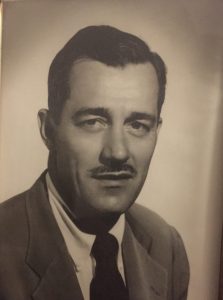
Nancy’s Father, Jim
7. What was the biggest trouble you ever got in?
We did anything to be annoying when we were at boarding school. I purposely tried to get kicked out. I would slide down bannisters and lean on the chairs to tip them forward, which was against the rules. One time, since I knew the nuns read our mail before sending it, I wrote a letter to my dad and said that all the kids hate this school and they’re all going to quit. The nuns came into study hall later that day to get me and send me to the principal. But the principal didn’t punish me – she just said that she didn’t like the school either!

A 1940s-Style Classroom
8. Did you have any good memories from boarding school?
When the St. Louis Cardinals won the World Series in 1942, we got to walk down to Grand Avenue to buy a soda, which cost a nickel.

9. How did World War II affect your life (age 10-14)?
All males in family that were draft age were gone – all my cousins and uncles. My dad didn’t have to go because he fell under the category of “one surviving parent”. We worked hard. We did newspaper drives, scrap drives and knitted for the Red Cross. Girls in the neighborhood got together on Friday nights and we’d have our meetings and report on what we’d done that week. When we were ten or so, we would also play “spy”. We spied on anybody that had a German-sounding last name, looking in their windows to see if they were doing anything suspicious. We especially wondered about the shoemaker and the baker…

10. How did you meet Grandpa (1940s)? I met him on a hayride in eighth grade, but just briefly. A few months later, I was walking down the street where he lived and he was out in his front yard, raking leaves. I was really embarrassed because my sister Pat had actually borrowed a pair of his jeans from his older sister Pat, and I had taken those same jeans from my sister to wear that day. So when I walked by him, I was actually wearing his jeans! And he barely knew me! I tried to walk really fast so he wouldn’t see me, but he saw me and said hi. I said hi back and kept walking as fast as I could. But he wondered who I was and eventually got my number from his sister. He called me later on and asked me to his high school dance. Then we dated off and on in the following years, becoming exclusive his sophomore year of college.


My Grandfather Don
11. What were the first few years of married life like for you (1950s, living in California due to a navy posting)?
It was fun. No one had a lot of money, though. One time, Grandpa had asked his uncle and and a high-ranking navy friend for dinner, but we didn’t have enough money to buy food for a nice meal. We said a prayer before we went to bed, and planned to pawn our camera for money the next day. However, when we woke up, it was like our prayers had been answered – we went to open our mail box, and found a check from a priest back home – he had sent it to us for a wedding present! We were thrilled and were then able to buy a roast with the money.
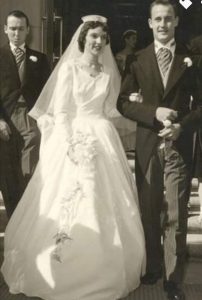
Don and Nancy at Their Wedding, 1954
12. What was it like being a navy wife?
Most the officers and navy wives had calling cards. They would come visit you, put their calling card on a silver tray you were supposed to have sitting out for that purpose, and then you were supposed to return the visit and put your calling card in their tray. We didn’t have the money for cards and silver tray, so when the commanding officer came to visit, he put his card in an ash tray. I played bridge with the other navy wives. My best friend was Betty from Chicago. We had a television and they didn’t, so they’d come over and watch shows with us.
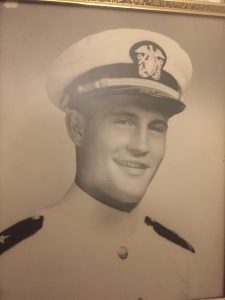
Don in his Navy Uniform, 1950s
Today, Nancy is the matriarch of our extended family, which consists of her ten children, their spouses, twenty-seven grandchildren and even one great-grandchild. Although her days of fly soup-making and shoemaker-spying are long past, her stories live on in the hearts of all her family, inspiring us all to appreciate things like watermelon, vacuums and ice cubes a little bit more.

Nancy, bottom left, with her entire family in 2015
23 Responses
How interesting to find out a similar-in-age woman from another part of the country had almost the same childhood experiences. I love the 1930-1940 years. We could walk at nights, ride the buses anywhere without fear, played outside until the bugs began to bite in the summertime.
Thank you for the interview.
Thanks for reading Vivian! It does sound like a wonderful time.
So very different from my Mom’s life growing up on the family farm during the depression, and then, at the age of 22, moving halfway across the country to LA during WWII.
When I was in graduate school in the late 1970’s, oral history was “THE thing” & for a class project I interviewed an elderly woman, who was my future husband’s grandmother. She died before our 3 children were old enough to remember her. I am so happy I have her voice telling about growing up as a girl in the early 1900’s in her small Wisconsin town. This recording. along with the photos we have of her my 2 eldest children in 4 generation photos, is a wonderful way for them to relate to their 1st gt. grandmother. I highly recommend preserving audio or audio-visual recordings to everyone doing their genealogical research as part of your legacy.
I always remembered that my girl friends and I didn’t play inside their houses. My mother did say that she didn’t want to clean up afterward….this was in the 40s and early 50s after WWII. I always did wonder why I couldn’t have friends inside to play and never knew that this was apparently common among mothers then.
That’s so fascinating! I wonder when that changed? Thanks for sharing, Arlene!
Even though I was a few years later being born in 1939, so much of it sounds like my childhood in S. Illinois. However, we kind of lived in the “country” with fewer kids to play with, one room school for several years and generally didn’t know what we we missing out on when we did without. Progress may come but beautiful memories of a gentler era remain.
Love that – thanks so much for sharing, Jo!
I really enjoyed reading this. Thanks for sharing the memories of your grandparents.
Thanks so much, Tami – I’m glad you enjoyed it!
Katherine,
What a fascinating and inspiring story aka interview of your grandmother Nancy! Thanks so much for sharing it!
Thanks so much for reading, Anne!
I loved your picture comparison with your grandmother! I always read your posts, as they are very informative.
Thanks, Davine! I love that picture of her!
I was born in 1931 in Connecticut. I remember many of those things mentioned by others….. The ice man bringing a chunk of ice for the tin- lined top of the ice box in the summer. In the winter I kept my toys up there, and it was cold enough to keep some food outside. The coal company would pour coal through a window into the cellar for the furnace. My father had to shovel it into the furnace for heat that would come up through the vents in the walls. We didn’t have hot water, so heated it in a kettle for baths. Somehow we got clean in an inch or two of warm water in a claw foot tub – even when I was a teenager!
Oh that’s fascinating about the coal, Shirley! And the baths – wow! Thanks so much for sharing your stories!
Your grandmother must have lived very near my mother in north St. Louis. My mother told stories of hearing the crowd noise from the ballpark while at school. And how she convinced her mother to stand in line to hold her place for the World Series, so she could walk over after school and get in. She also told stories of the ice man and how he chipped off pieces of ice for the kids in the hot weather.
She grew up in Richmond Heights, so not too far away! That’s a great story about the World Series – I love it! Thanks for sharing, Kim!
Both of my parents were born in 1930. My father on a farm in Kansas and my mother in Kansas City, Missouri. Dad went to a Lutheran church school, classes were still taught in German. He moved to Oklahoma city when he was 12, remembered getting called out of class with several boys and sent to the principal’s office when WWII ended. They were released to sell newspapers about the war’s end. He also got to work on his uncle’s wheat farm in northern Oklahoma in the summer and had fun learning to operate the farming equipment. Mom’s mother was a nurse prior to marriage. The kitchen got scalded every year prior to doing the canning and every night they poured a kettle of scalding water over the freshly washed dishes. Her mom also trained farm girls to wait on tables so that they could earn a living. They used their best china and silver ware for Sunday dinners. My grandfather was a Lutheran minister and started his career working at inner city churches. My mother loved going to the services of his black congregations because of the lively singing. Others in the community were not happy with his work and burned a cross on his lawn. My mom said the kids in her neighborhood shared toys. When someone got a bike everyone was allowed a turn. In the winter the city blocked off a hill for the kids to sled on and opened a fire hydrant so the water would freeze on the road. Both of my parents remembered having their tonsils removed on the kitchen table.
What great memories and stories! Love reading all of this – thanks so much for sharing, Linda!
I found not playing in a friends house interesting. In that time frame my best friend and I played at each other’s homes , we had overnights, just like my own children in the 1960-70 era. It was a small town so maybe that was the difference.
Interesting! I can imagine it differed from place to place.
Soooo many memories!!! I was born in ’35,in October of ’37 my Dad was diagnosed with TB,died 18 months later..Mom was pregnant with #5, (I was #4), next brother and I were sent to Gramma 400 miles away. I did not like farm life after my brother left to go to school. Gramp leased the farm in 43 and we moved to the city, that was better. I remember all the stuff people talked about previous, games, friends, school, uniforms,the War, the Red Cross meetings with all the women and I was the only kid, the newspaper drives, saving gum wrappers, rubberbands, walking miles for sugar, ration stamps for everything! It definitely was a different era! We all wore hand-me-downs! nobody had anything new! Best friends who really were! Roller skates, and a layaway program to buy things on time, and you didn’t get it until it was paid for! War bonds, stamps in a book to buy one a little at a time! Good old days!